
A pendant has a small, practical job: hold a stone safely, let light reach it, and sit comfortably against the skin. In handcrafted quartz jewelry, two constructions do most of that work. One wraps the stone in wire. The other frames it in a fitted band of metal. They photograph similarly on a neck, but they behave very differently in daily life — in how they look, how exposed the stone is, how the piece hangs, and what you have to do to keep it in good shape. Here is an honest comparison, based on how each style is actually made.
Two Constructions, Side by Side
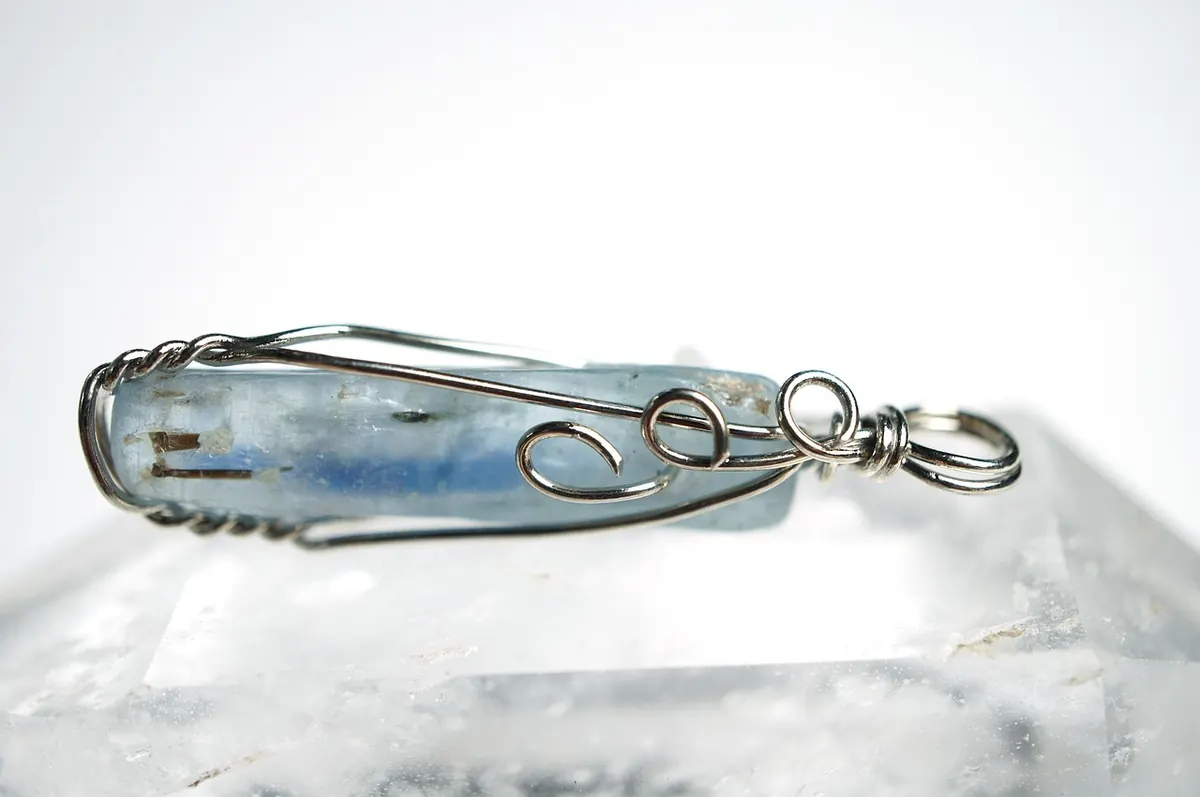
A wire-wrapped pendant is built from the outside in. The maker forms a cage around the stone using wire — often 18 to 22 gauge — with prongs that cross the face, binding wraps that cinch the stone at its widest point, and a bail worked into the same continuous structure. Nothing is soldered. The wire is the setting, the frame, and usually part of the design.
A bezel setting is built the other way around. A strip of metal, sized to the stone's outline, is fitted around the girdle — the outer edge of the stone — and soldered to a backplate, or left open at the back. The top edge of that strip is then pushed inward with a bezel roller and a burnisher until it grips the stone. Wire wrapping is closer to basketry; bezel setting is closer to cabinetmaking. Both hold a stone. Only one of them hides its seams.
How They Look
Wire wrapping shows its hand. You see the line travel around the stone, the small crossings, the point where a prong turns into a decorative curl. On a raw quartz point, a tumbled nugget, or an irregular slab, that visible structure is an advantage: the metal follows the stone's odd shape instead of apologizing for it. Wire also keeps a large stone from looking heavy, because there is open space between the wraps.
The risk is busyness. Heavy sculptural wire can compete with a stone that already has a lot going on — a rutilated quartz full of gold needles, for instance, or a deeply included garden quartz. Thin wire has the opposite problem: it looks delicate and elegant, but every slight bend shows.
A bezel is quiet. It draws one clean line around the stone and then gets out of the way, which suits faceted rounds and ovals and symmetrical cabochons. It also hides chips and roughness along the girdle, and an open-backed bezel lets light pass through a pale or clear quartz instead of trapping it. If you want the stone to be the only thing anyone notices, the bezel usually wins.
Security and Daily Wear
A well-made bezel is the more protective of the two. The stone's edge is covered all the way around, so there is nothing to catch on a sweater, and a bump is absorbed by metal rather than by quartz. That matters, because quartz is hard — around 7 on the Mohs scale — but brittle, and chips at the girdle are the most common injury it suffers. The trade-off is access: you cannot easily inspect the stone, and if a bezel does loosen after a knock, tightening it is a jeweler's job.
Wire security depends almost entirely on the maker. A stone held at four or more points, with snug binding wraps and work-hardened wire, is genuinely secure. A stone held by two thin loops on a heavy piece is not, no matter how pretty the curl is. Wire also has stress points at every bend, and repeated bending will eventually fatigue the metal.
If you are buying a wire-wrapped pendant, handle it first:
- Check that at least three or four prongs cross the face of the stone, not just the sides.
- Press gently on the stone and watch for rocking. Any movement is too much.
- Look at the binding wraps — they should sit tight, with no visible gaps.
- Inspect the ends: filed and rounded, not sharp cut wire tucked underneath.
- Test the bail. Two wires or a reinforced loop will outlast a single strand.
- Run a fingertip around the inside of the bail and along the back for burrs.
Weight, Balance, and How It Sits
Bezels carry more metal: a wall plus a backplate adds weight, particularly on larger stones. That weight is usually an asset. A bezel-set pendant sits flat and low, stays put when you lean forward, and rarely flips, because the mass is spread evenly behind a wide base.
Wire pendants can be lighter and more sculptural, but balance is trickier. A big stone in thick wire can become top-heavy, so the pendant tips forward and the chain slides. Bail placement matters more here than in any other detail. Ask to see a wire pendant hanging free — not laid flat — before you decide. If you wear your chain short, near the collarbone, note that wire pieces often sit slightly further off the chest, which changes how they catch the light and how often they meet a table edge.
Care and Cleaning
Neither style needs fuss, but they need different kinds of attention. Warm water, a drop of mild soap, and a soft brush suit both. Rinse and dry thoroughly — especially closed-back bezels, which can hold moisture against the backplate.
- Clean quartz pendants with mild soap and water; skip ultrasonic and steam cleaners unless a jeweler confirms they are safe for your stone, particularly if it is dyed, treated, or fractured.
- For bezels, check the setting every few months. A thin gap opening between metal and stone after a knock means a repair, not a wait-and-see.
- For wire, dry the seams between wraps with a cloth; trapped moisture is where tarnish starts and where you cannot reach to polish.
- Polish silver with a soft cloth. Avoid liquid dips on oxidized or antiqued wire — they strip the darkened recesses that give the piece its depth.
- Store both flat in a soft pouch. Crushing a wire cage in a crowded jewelry box bends prongs that are hard to reshape.
Copper and brass wire will darken over time, and copper can leave a faint greenish mark on skin, which is normal rather than a defect. If a piece ever leaves your skin irritated, set it aside and have the metal checked.
Matching the Style to the Stone and the Wearer
Let the stone lead. Raw points, asymmetric slabs, tumbled nuggets, and anything with an interesting irregular edge tends to look better wrapped — the wire can follow what the stone actually is. Faceted stones, symmetrical cabochons, and quartz with a thin or fragile girdle belong in a bezel. So do stones whose inclusions reach the surface, since a bezel guards the edge they sit on.
Then consider your habits. If you wear a pendant every day, under scarves, through doors, and to bed once in a while, the enclosed bezel is the more forgiving companion. If you rotate pieces, dress them up for evenings, and enjoy jewelry that looks made rather than manufactured, wire wrapping gives you a range of shapes a bezel cannot. And if a pendant ever needs resizing or repair, note that a wire design can sometimes be adjusted by its maker, while a bezel generally goes to a jeweler.
A Simple Way to Decide
Hold each one against your neck, in a mirror, wearing the collar you actually wear. Watch what happens when you lean forward. Then ask yourself which maintenance you will keep up with: checking a bezel edge every few months, or drying and storing a wire piece flat so the cage keeps its shape.
Ask the maker two questions before anything goes home — how many points hold the stone, and what the metal is (sterling silver, fine silver for the bezel wall, copper, brass). The answers tell you more than a photograph ever will. Buy the piece you will reach for, and let the setting serve the stone rather than the other way around.
Photo: starbright / Pixabay